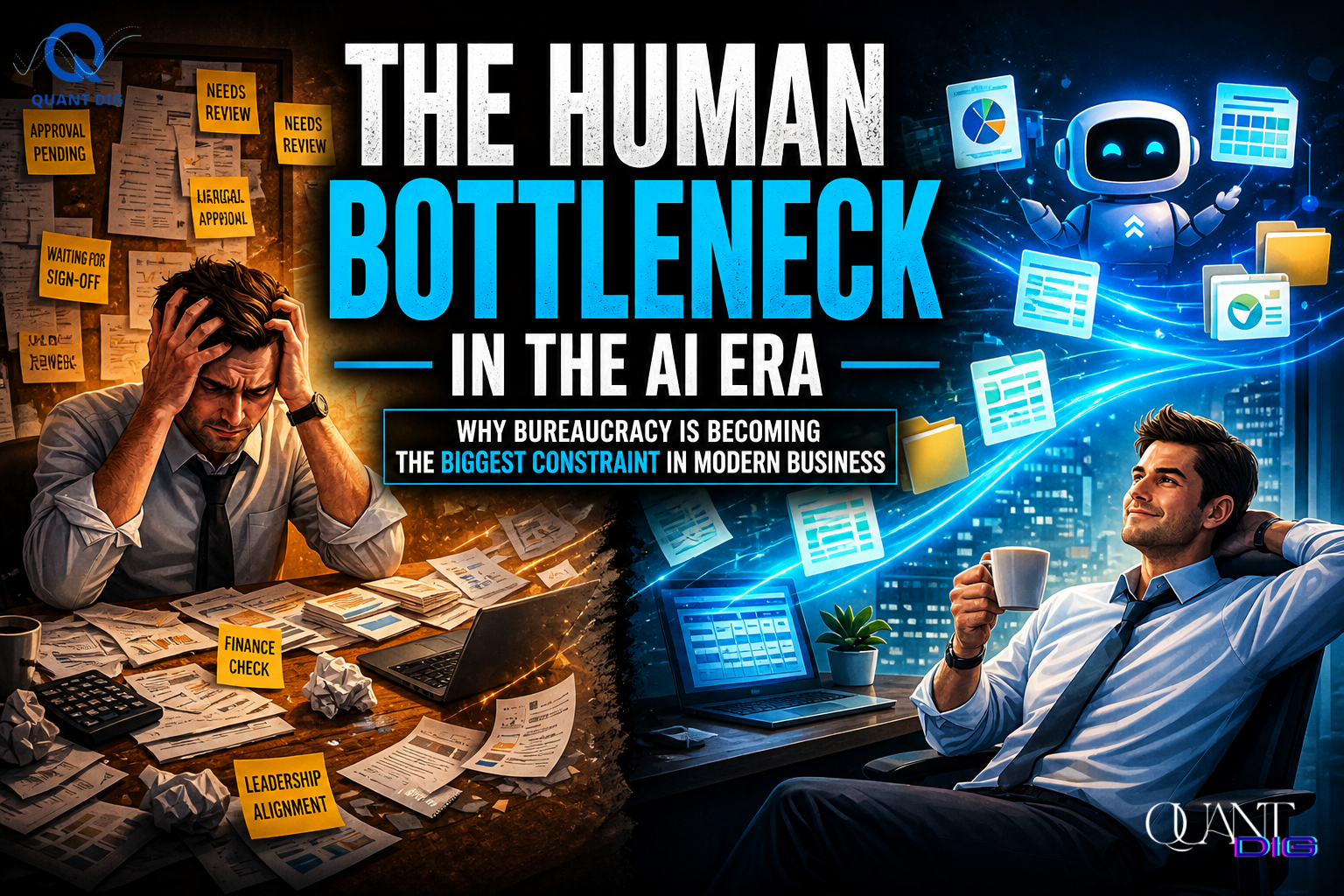
As machines accelerate, the slowest part of every system is becoming painfully obvious: human coordination, approval, and execution.
“AI can think in seconds. Most organizations still decide in weeks.”
Not long ago, the biggest limitation in technology was computational power.

Machines were too slow.
Models were too weak.
Automation was too expensive.
That era is ending.
Today, AI can generate code, analyze contracts, produce designs, answer customers, draft strategy memos, automate workflows, and process information faster than entire departments once could.
And yet most organizations still move at the same speed they did five years ago.
Why?
Because the constraint is no longer technology.
It’s people.

AI Is No Longer the Bottleneck
The infrastructure is here.
Models are improving monthly.
Inference costs are falling.
Tools are becoming accessible to everyone.
For many companies, the technical barrier to adopting AI has dropped dramatically.
But productivity gains remain underwhelming.
Not because AI underperformed—
but because organizations were never designed to move at machine speed.
Human Approval Chains Create Artificial Latency

An AI can draft a proposal in 30 seconds.
Then it waits:
- For a manager to review
- Another stakeholder to approve
- Legal to sign off
- Finance to validate
- Leadership to align
The machine finishes instantly.
The organization takes two weeks.
This is the new form of latency in modern business:
Human coordination delay.
Bureaucracy Is Becoming More Expensive Than Ever

In the industrial era, bureaucracy was tolerable.
When production cycles were slow, human process overhead barely mattered.
In the AI era, that same bureaucracy becomes catastrophic.

Every unnecessary approval step now compounds opportunity cost.
Every delayed decision wastes near-instant execution capacity.
Companies are discovering a painful truth:
Buying AI does not create speed.
Removing friction does.

AI-Native Organizations Will Be Structured Differently
The winners of the next decade will not simply use AI.
They will redesign around it.
That means:
- Smaller decision loops
- Fewer approval layers
- More autonomous teams
- Greater delegation
- Trust in systems over hierarchy
The most successful firms will look less like traditional corporations and more like high-speed operating systems.

The New Competitive Advantage Is Organizational Throughput
For decades, scale was the moat.
Then distribution became the moat.
Then data became the moat.
Now a new moat is emerging:

How quickly your organization can convert intelligence into action.
Two companies may have access to the same AI.
The one that acts faster wins.
Not because it has better tools—
but because it has less internal drag.
Final Thought
The future will not be divided between companies that have AI and companies that do not.
It will be divided between:
- Organizations that adapt their structure to machine-speed execution
- And organizations that keep forcing machine-speed tools through human-speed bureaucracy

Because in the AI era:
The most valuable companies won’t be the ones with the smartest machines.
They’ll be the ones with the fewest human bottlenecks.