
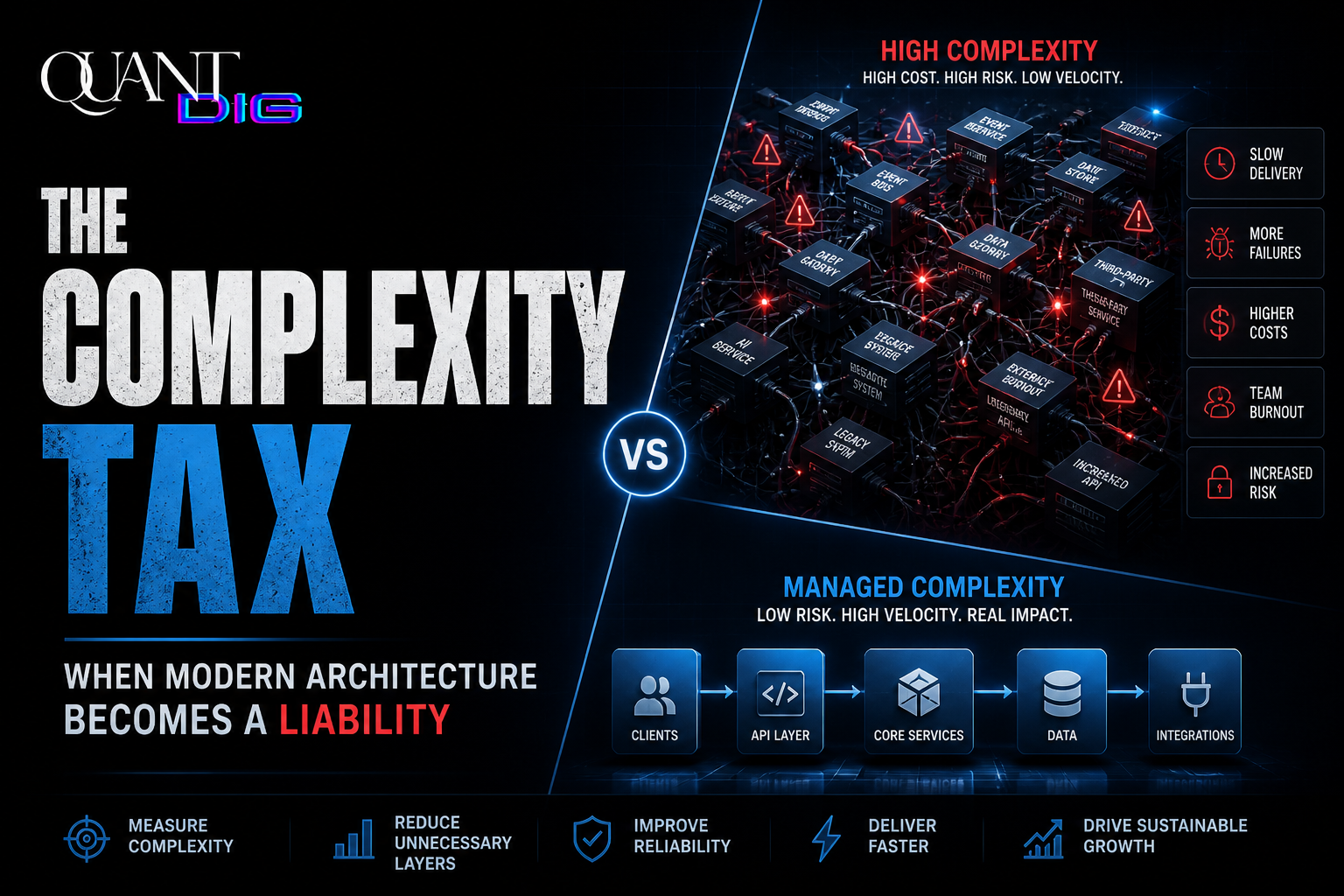
When Modern Architecture Becomes a Liability

Introduction: The Promise of Modern Architecture
Over the past decade, modern software architecture has evolved rapidly.
Microservices replaced monoliths.
Cloud replaced on-premise infrastructure.
Event-driven systems replaced synchronous flows.
AI layers are now being added on top.

The promise was clear:
More flexibility. More scalability. More speed.
But in many organizations, the outcome has been the opposite.
Systems have become harder to understand, slower to change, and riskier to operate.
At QuantDig, we call this hidden cost The Complexity Tax.

What Is the Complexity Tax?
The Complexity Tax is the operational and engineering cost introduced by unnecessary or unmanaged complexity in a system.
It is not always visible in architecture diagrams.
It emerges in day-to-day execution.
It shows up as:
- Longer release cycles
- Difficult debugging and incident resolution
- Increased dependency chains
- Higher onboarding time for engineers
- Fragile integrations across services
Complexity does not announce itself.
It accumulates quietly.
When Modern Becomes Over-Engineered

Not all complexity is bad. Some is necessary.
But problems begin when organizations adopt modern patterns without clear need.

Common triggers include:
- Premature microservices adoption
- Multi-cloud without strategic justification
- Excessive tooling and frameworks
- “Future-proofing” systems that are still small
What begins as modernization often turns into fragmentation.

The Illusion of Advanced Architecture

Many systems look modern from the outside.
They use:

- Kubernetes
- APIs
- Event buses
- AI pipelines
But internally:

- Services are tightly coupled
- Data flows are unclear
- Ownership is fragmented
- Failures cascade across systems
The architecture appears advanced, but behaves unpredictably.
Where the Complexity Comes From

The Complexity Tax is rarely intentional. It is often a result of decisions made over time.
Key sources include:

- Copying large-scale architectures (e.g., FAANG) without similar scale
- Vendor-driven stack decisions
- Lack of clear system ownership
- Continuous layering without simplification
- Rapid hiring without architectural discipline

Each decision seems rational in isolation.
Together, they create systemic complexity.
The Real Cost of Complexity

The cost of complexity is measurable.
It impacts:

1. Delivery Speed
Changes take longer due to cross-service dependencies.
2. Reliability
Failures propagate across multiple systems.
3. Engineering Productivity
More time is spent understanding systems than building them.
4. Cost
Infrastructure, tooling, and maintenance costs increase significantly.
5. Risk
The system becomes harder to reason about under pressure.
Simple Systems vs Complex Systems

Simple does not mean primitive.
Well-designed simple systems:
- Are easier to understand
- Are faster to change
- Fail in predictable ways
- Require fewer coordination layers

Complex systems require strong discipline to remain manageable.
Without that discipline, they degrade quickly.

Introducing the QuantDig Complexity Score

To make complexity measurable, QuantDig proposes a Complexity Score based on:
- Number of services and dependencies
- Change impact radius
- Observability depth
- Deployment coordination effort
- Ownership clarity
- Failure isolation capability

Organizations with high scores are not necessarily advanced —
they are often fragile at scale.

The QuantDig Perspective
Modern architecture is powerful. But power without control creates instability.
The goal is not to avoid complexity entirely.
It is to earn it only when necessary.
The most effective organizations:
- Keep systems as simple as possible
- Introduce complexity deliberately
- Continuously refactor and reduce unnecessary layers
Because in real-world systems:
Complexity does not scale — discipline does.
Closing Thought
In the race to modernize, many companies are optimizing for appearance instead of performance.
But over time, the winners are not the most complex systems.
They are the ones that remain understandable, adaptable, and resilient.
That is how organizations avoid the Complexity Tax —
and turn architecture into an advantage, not a liability.