Why Customers Stop Trusting Companies Before Revenue Drops


Introduction: The Collapse Rarely Starts in Public
Most companies believe they will recognize a trust problem when the numbers decline.
Revenue falls.
Users churn.
Complaints rise.
Engagement drops.
But trust rarely collapses all at once.
In reality, customer trust begins eroding long before business metrics visibly react.
At QuantDig, we call this hidden delay:
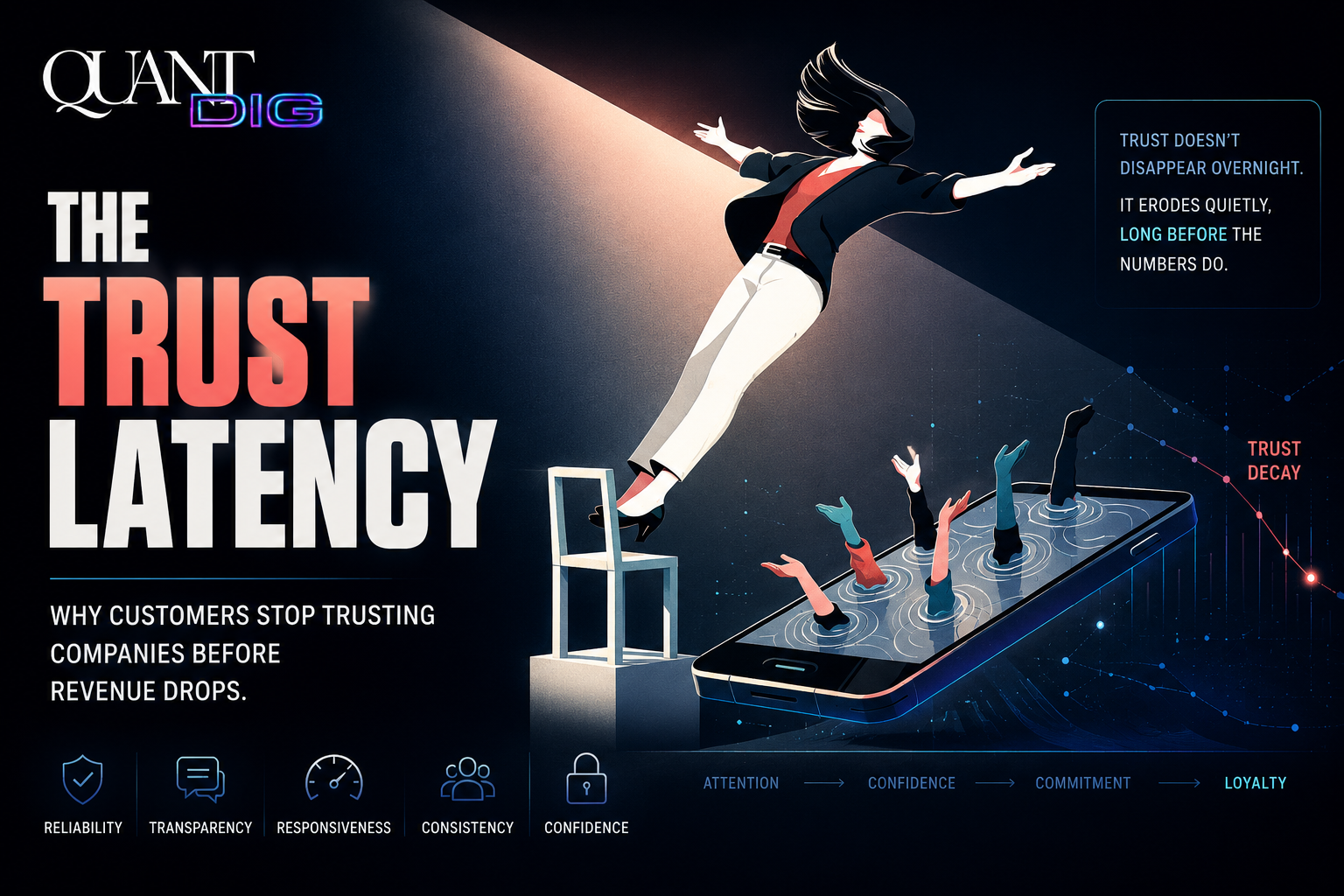
The Trust LatencyThe gap between operational decline and customer departure.
And in modern digital businesses, that gap is becoming one of the most dangerous blind spots in enterprise strategy.
Trust Is Not a Brand Asset Anymore


For years, companies treated trust as a branding problem.
Better advertising.
Better messaging.
Better positioning.
But in digital-first industries, trust is increasingly shaped by operational behavior.
Customers trust companies that:
- Work consistently
- Recover quickly
- Communicate transparently
- Reduce friction predictably
Trust is no longer built primarily through marketing.
It is built through systems.
Tiny Failures Compound Quietly


Most trust erosion does not begin with catastrophic outages.
It begins with small, repeated inconsistencies.
- A delayed transaction
- A login issue
- A failed OTP
- A support ticket ignored
- A feature behaving unpredictably
Individually, these seem minor.
Collectively, they create emotional instability between the customer and the platform.
Over time, users stop feeling confident — even before they consciously decide to leave.
Customers Leave Emotionally Before Financially


One of the most misunderstood realities in business is this:
Customers often leave mentally long before they leave financially.
They begin:
- Using alternatives quietly
- Reducing engagement
- Avoiding important workflows
- Losing confidence in reliability
Revenue may remain temporarily stable.
But psychologically, the relationship is already weakening.
This delay creates the illusion that everything is functioning normally.
Trust Is an Infrastructure Layer


In modern enterprises, trust behaves like infrastructure.
It depends on:
- Reliability
- Consistency
- Predictability
- Operational discipline
Every deployment, every incident response, every support interaction contributes to trust architecture.
Companies with weak operational foundations eventually expose that weakness externally.

Trust becomes fragile when systems become fragile.
The Hidden Signals of Trust Decay


Trust decay rarely announces itself directly.
But the signals exist.
QuantDig identifies early indicators such as:
- Increased retry behavior
- Higher session abandonment
- Reduced feature adoption
- Negative community sentiment
- Longer support resolution cycles
- Silent churn patterns
These signals appear before financial damage becomes visible.
Organizations that ignore them often react too late.
AI May Increase the Trust Latency


AI introduces a new layer to the problem.
Modern AI systems can:
- Automate responses
- Generate polished communication
- Simulate responsiveness
- Reduce visible friction temporarily

This creates a dangerous possibility:
AI may delay visible trust collapse while underlying operational quality continues deteriorating.
The customer experience may appear intelligent.
The operational foundation may still be unstable.
This widens the Trust Latency.
Why Reliability Is Becoming the New Branding


In increasingly saturated digital markets, product features are easier to copy.
Reliability is not.
Customers remember:
- Which platform failed during urgency
- Which app handled pressure gracefully
- Which company recovered transparently
Over time:
- Reliability becomes reputation
- Stability becomes differentiation
- Predictability becomes brand equity
The strongest brands may soon be the most operationally disciplined.
Introducing the QuantDig Trust Index


To measure trust operationally, QuantDig proposes a future-facing framework:
The QuantDig Trust Index
Scoring companies across:
- Reliability consistency
- Incident transparency
- Recovery speed
- UX predictability
- Support responsiveness
- Operational stability
Because trust is no longer abstract.
It is measurable infrastructure.
The QuantDig Perspective
Most companies monitor revenue carefully.
Far fewer monitor trust decay with the same seriousness.
But in digital ecosystems, trust behaves like structural integrity.
By the time collapse becomes visible externally, the internal damage is often already deep.
The next generation of winning companies will not simply optimize:
- Growth
- Engagement
- AI adoption
They will optimize for:
Long-term customer confidence.
Because in a software-defined economy, trust compounds slowly —
and collapses suddenly.
Closing Thought
Customers rarely announce the exact moment they stop trusting a platform.
The shift happens quietly.
A second thought before making a payment.
A hesitation before updating data.
A backup app installed “just in case.”
That is the beginning of Trust Latency.
And the companies that learn to detect it early may become the most resilient organizations of the next decade.