A Strategic Framework for Building AI Systems That Survive Reality

Introduction: Most AI Failures Start Before Development
Modern AI projects rarely fail because models are weak.
They fail because organizations choose the wrong architecture before understanding the real problem.

Some teams:
- Build multi-agent systems for simple workflows
- Introduce orchestration where retrieval was enough
- Add memory before defining context boundaries
- Scale infrastructure before validating usefulness
The result is increasingly common:
AI systems that look sophisticated — but collapse under operational reality.
At QuantDig, we believe the most important AI decisions happen before implementation begins.
Not during coding.
During architecture thinking.

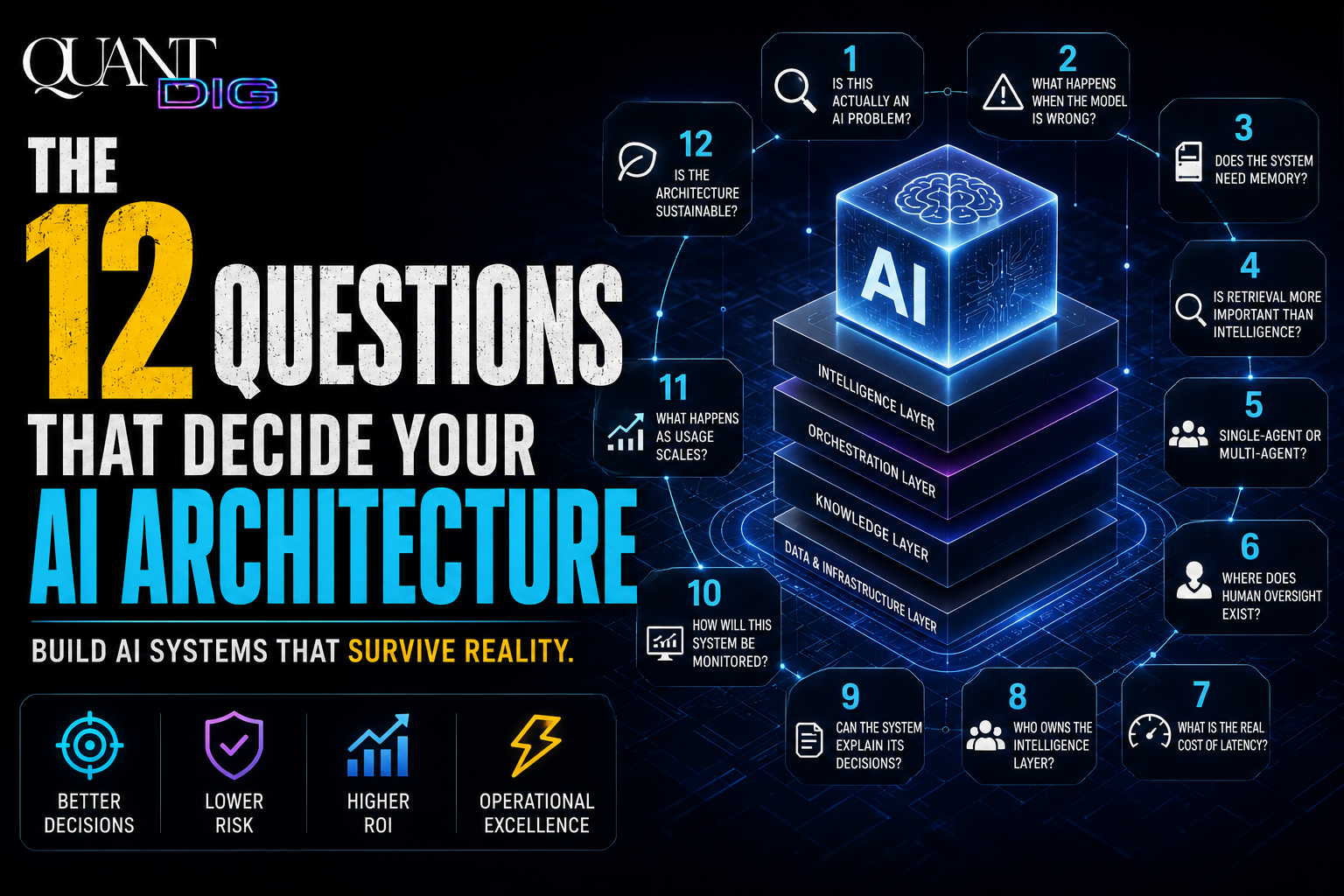
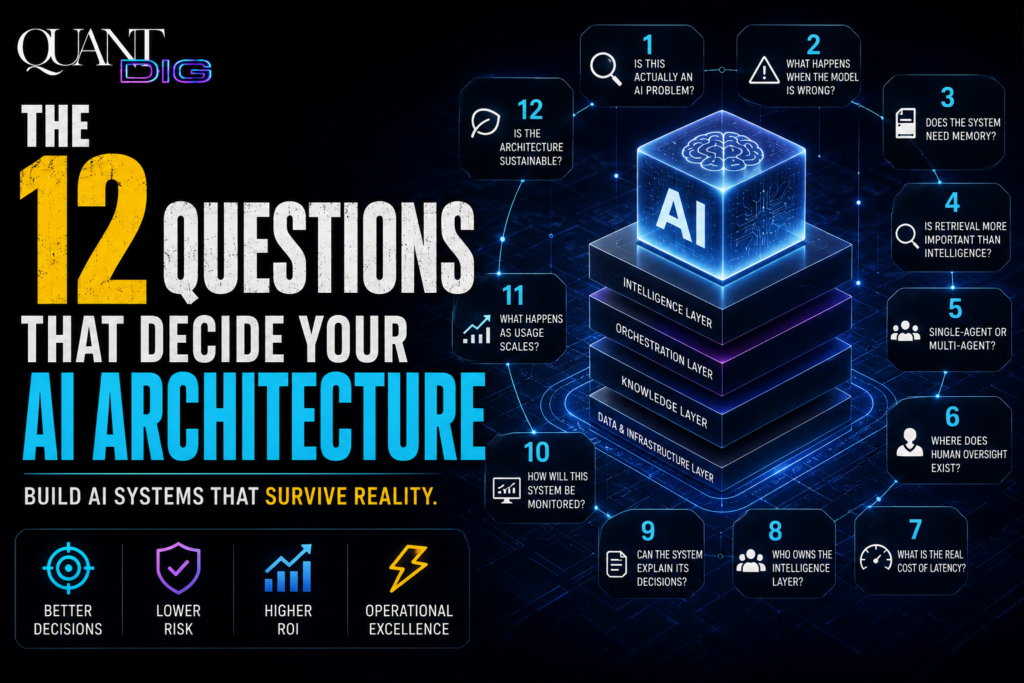
This article introduces the 12 Questions That Decide Your AI Architecture — a framework for designing AI systems that remain useful, scalable, and operationally stable.
1. Is This Actually an AI Problem?

Many organizations force AI into problems that are better solved with:
- Rules engines
- Search systems
- Workflow automation
- Traditional software logic

AI should exist where ambiguity, reasoning, or generation is genuinely required.
Otherwise:
- Cost increases
- Reliability decreases
- Complexity grows unnecessarily

The first architectural decision is deciding whether AI is needed at all.
2. What Happens When the Model Is Wrong?


Every AI system will eventually produce incorrect output.
The real question is:
What happens next?
High-risk systems require:
- Human review layers
- Confidence thresholds
- Rollback paths
- Verification workflows
Architecture is not just about intelligence.
It is about failure containment.
3. Does the System Need Memory?


Not every AI workflow needs persistent memory.
Memory increases:
- Personalization
- Context continuity
- Long-running workflow capability
But it also increases:
- Privacy risk
- Complexity
- Storage overhead
- Context pollution
Memory should be introduced deliberately, not automatically.
4. Is Retrieval More Important Than Intelligence?


In enterprise AI systems, the biggest limitation is often not reasoning.
It is access to accurate information.
A smaller model with strong retrieval frequently outperforms a larger model with weak context access.
This changes architectural priorities dramatically.
Sometimes:
Retrieval quality matters more than model sophistication.
5. Should This Be Single-Agent or Multi-Agent?


Multi-agent systems are becoming popular.
But many are architecturally unnecessary.
Multiple agents increase:
- Coordination overhead
- Latency
- Debugging difficulty
- Failure surfaces
The question is not:
“Can multiple agents help?”
The real question is:
“Does the workflow genuinely require specialization?”
6. Where Does Human Oversight Exist?


Fully autonomous AI systems sound impressive.
But enterprise reality demands accountability.
Human checkpoints are often required for:
- Compliance
- Security
- Financial decisions
- Customer communication
The strongest architectures balance automation with controlled intervention.
7. What Is the Real Cost of Latency?


Some AI workflows tolerate delay.
Others do not.
Latency affects:
- User trust
- Operational flow
- Decision-making speed
- Infrastructure cost

Fast AI systems require architectural trade-offs:
- Smaller models
- Caching layers
- Edge inference
- Reduced orchestration complexity
Speed is an architectural decision.
8. Who Owns the Intelligence Layer?

One of the most overlooked questions in AI architecture is ownership.
Who maintains:
- Prompt quality?
- Model evaluation?
- Safety policies?
- Retrieval pipelines?
- Agent coordination?
Without ownership clarity, AI systems decay quickly.
9. Can the System Explain Its Decisions?


Opaque intelligence creates operational risk.
Especially in:
- Banking
- Healthcare
- Enterprise compliance environments
Modern AI systems increasingly require:

- Traceability
- Explainability
- Decision lineage
- Audit-ready reasoning paths
Trust requires visibility.
10. How Will This System Be Monitored?

Traditional monitoring is not enough for AI systems.
Modern AI observability requires tracking:
- Hallucination rates
- Drift behavior
- Retrieval accuracy
- Prompt failures
- Agent loops
- Cost spikes

If AI systems cannot be observed clearly, they cannot scale safely.
11. What Happens as Usage Scales?

Many AI systems work well in demos.
Then collapse at scale.
Scaling introduces:

- Cost explosions
- Token inefficiency
- Queue bottlenecks
- Context management problems
- GPU allocation complexity
AI scalability is not just model scalability.
It is workflow scalability.
12. Is the Architecture Sustainable?

The final question is the most important.
Can the organization realistically maintain this architecture over time?
Many systems become:
- Over-engineered
- Difficult to debug
- Dependency-heavy
- Operationally fragile
The best AI architecture is rarely the most complex.
It is the one the organization can continuously understand, improve, and operate.
The QuantDig Perspective
AI architecture is entering the same phase cloud architecture once did:
A phase where complexity is accelerating faster than operational discipline.

The winners will not necessarily build:
- The largest models
- The most agents
- The most advanced orchestration systems
They will build architectures that remain:
- Observable
- Maintainable
- Explainable
- Economically sustainable
- Operationally resilient
Because in enterprise AI:
Intelligence without architectural discipline becomes instability at scale.
Closing Thought

The future of AI will not be decided only by model capability.
It will be decided by architectural judgment.
The organizations asking better questions today may avoid the expensive redesigns, failures, and complexity traps that will define the next wave of AI systems.
And ultimately:
AI architecture is not about building systems that impress demos.
It is about building systems that survive reality.