The Collapse of AI Differentiation
There was a time when using AI felt like a superpower.

A well-crafted prompt could:
- generate software,
- design interfaces,
- write essays,
- create marketing campaigns,
- produce artwork,
- automate workflows.
The gap between people who understood AI and those who didn’t was enormous.
But something changed.
The tools became easier.
The interfaces became simpler.
The outputs became cleaner.
And slowly, the internet began filling with the same polished intelligence.
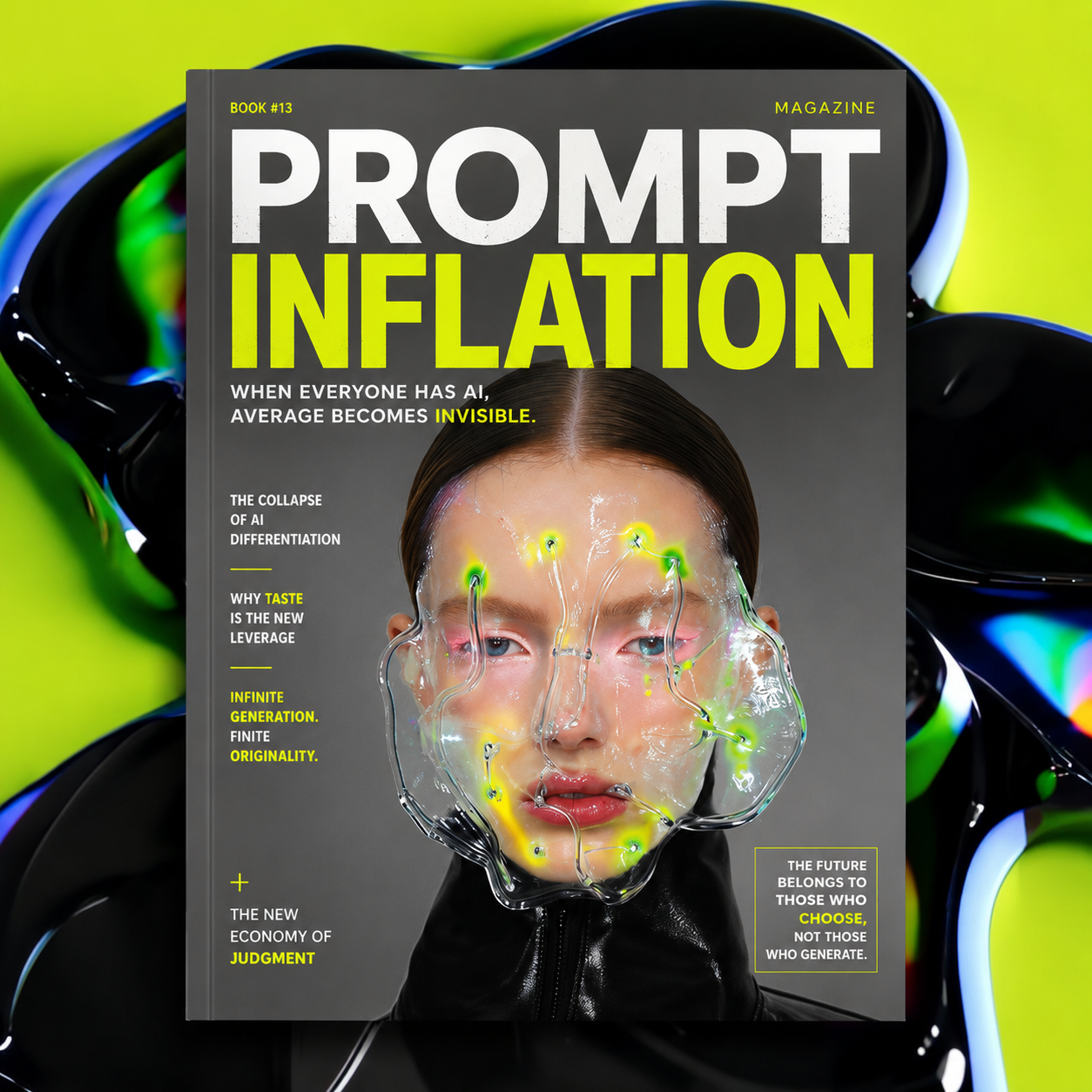
We are now entering an era of Prompt Inflation — a world where AI-generated excellence becomes so abundant that it loses its value.
The Democratization of Execution

Artificial intelligence did something extraordinary:
It lowered the skill floor of creation.
Tasks that once required years of experience now require:
- a browser,
- a sentence,
- and a few seconds.

Earlier:
- coding required engineers,
- design required designers,
- writing required writers.
Today, almost anyone can produce:
- decent code,
- decent visuals,
- decent copy,
- decent presentations.
AI industrialized “good enough.”
At first, this looked revolutionary.
But abundance changes economics.
When polished output becomes infinite, differentiation collapses.
The Rise of Synthetic Sameness
The modern internet is becoming visually impressive — and emotionally repetitive.
Everywhere you look:
- cinematic thumbnails,
- AI-generated posts,
- startup copy,
- motivational threads,
- “thought leadership,”
- hyper-polished designs.
Everything looks optimized.
Yet much of it feels strangely forgettable.
Why?
Because AI has standardized aesthetics faster than humans can evolve originality.
The result is a new phenomenon:
Generic excellence.
Content is becoming:
- technically impressive,
- strategically empty,
- emotionally interchangeable.

The future internet may not suffer from a lack of quality.
It may suffer from a lack of identity.
Prompting Is No Longer the Moat

In the early days of generative AI, prompting itself was leverage.
People who understood:
- system instructions,
- prompt chaining,
- tone control,
- context engineering,
could outperform everyone else.

But like every technological advantage, the moat began shrinking.
Today:
- prompt libraries exist,
- AI templates exist,
- custom GPTs exist,
- AI agents automate prompting itself.
The knowledge advantage is rapidly compressing.
Soon, prompting may become invisible infrastructure —
like typing on a keyboard.
Important once.
Expected later.
AI Raised the Baseline — Not the Ceiling
One of the biggest misconceptions about AI is that it automatically creates greatness.
It doesn’t.
AI raises the baseline quality of output.
That means:
- average presentations now look premium,
- average writing now sounds intelligent,
- average designs now feel modern.
But true originality still remains rare.
Because originality was never only about execution.
It was about:
- perspective,
- timing,
- emotional depth,
- contradiction,
- judgment,
- lived experience.

AI can imitate patterns.
But it still struggles to produce:
- conviction,
- cultural intuition,
- meaningful taste.
Taste Is Becoming the Ultimate Skill

The next generation of winners may not be the best creators.
They may be the best selectors.
In a world flooded with infinite generation:
- choosing matters more than producing,
- editing matters more than drafting,
- judgment matters more than speed.
The rarest resource of the AI era may become:

taste.
Not aesthetic taste alone.
But strategic taste:
- knowing what matters,
- what resonates,
- what deserves attention,
- what should exist at all.
AI made execution cheaper.
Human discernment became expensive.
The Coming Content Deflation Crisis
The internet is approaching a strange paradox:
We have more content than ever before —
yet attention feels increasingly exhausted.
Why?
Because abundance destroys perceived value.
When everyone can generate:
- articles,
- logos,
- videos,
- podcasts,
- advertisements,
- social posts,

the real scarcity becomes:
- trust,
- memorability,
- authenticity.
The future may belong less to those who create the most —
and more to those who create meaning.

Conclusion
Prompt Inflation is not the death of creativity.
It is the collapse of easy differentiation.
AI did not eliminate talent.
It amplified average output.
And in doing so, it changed the rules of value creation forever.
The next competitive advantage will not come from simply using AI.

It will come from:
- judgment,
- perspective,
- originality,
- restraint,
- and the courage to create something that does not look like everything else.
Because in the age of infinite generation,
the rarest thing on the internet may become: