Introduction: The Age of Performed Competence
Modern companies have become exceptionally good at looking intelligent.

Their presentations are polished.
Their dashboards are impressive.
Their AI initiatives sound visionary.
Their leaders speak the language of transformation fluently.
From the outside, they appear highly capable.
But capability is easy to simulate during stability.
The real test begins when:
- Systems fail
- Customers panic
- Scale increases suddenly
- Markets shift aggressively
- Execution pressure intensifies
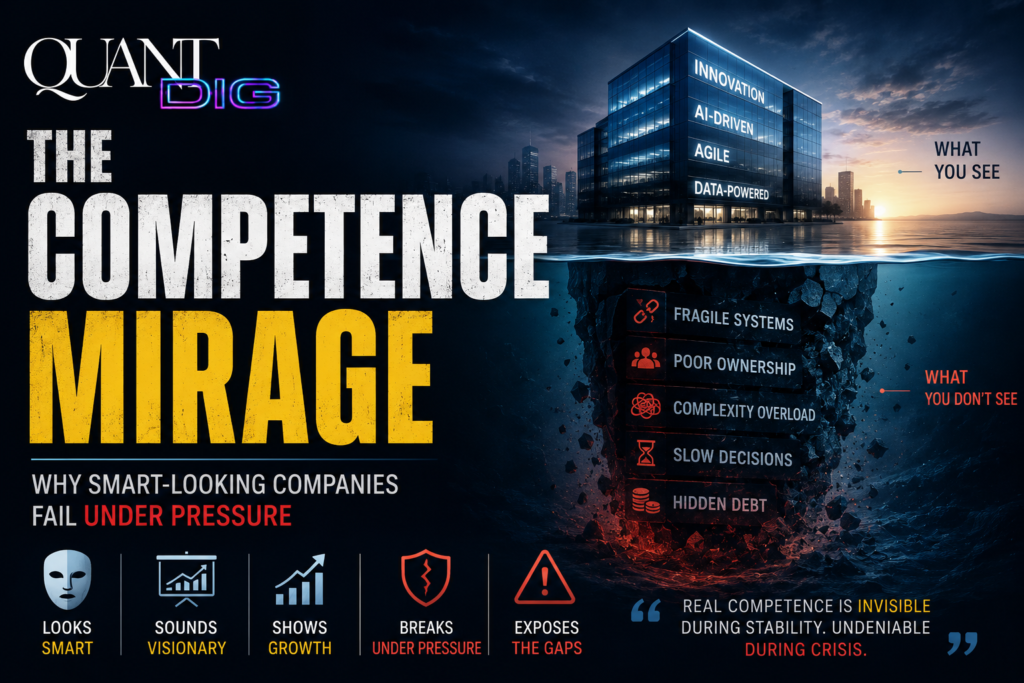
That is when many organizations encounter what QuantDig calls:
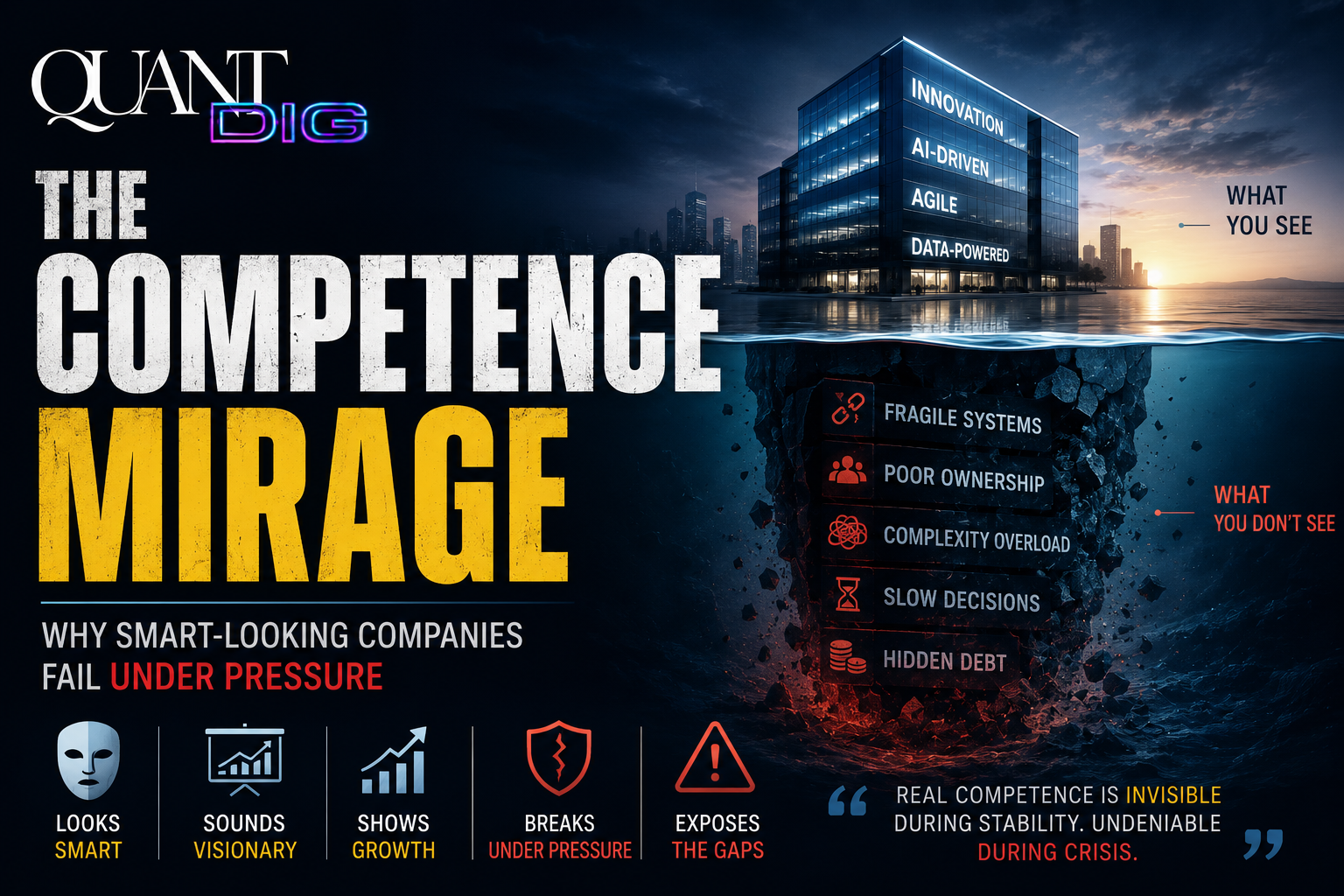
The Competence Mirage
The gap between perceived capability and operational reality.
The Difference Between Looking Advanced and Being Advanced
Today, it is easier than ever to appear technologically mature.
Companies can:
- Adopt AI terminology
- Deploy attractive analytics dashboards
- Announce cloud-native transformations
- Showcase automation publicly

But external sophistication does not always reflect internal strength.
Behind many modern-looking organizations are:
- Fragile processes
- Unclear ownership structures
- Operational bottlenecks
- Technical debt hidden beneath abstraction layers
The architecture appears modern.
The execution often remains unstable.
Pressure Reveals True Capability
Competence is difficult to evaluate during normal conditions.
Real capability becomes visible only during pressure.
When incidents occur, mature organizations:
- Communicate clearly
- Recover quickly
- Coordinate effectively
- Maintain operational discipline
Weak organizations do the opposite.
They:

- Escalate confusion
- Fragment decision-making
- Expose dependency gaps,
- React emotionally instead of systematically
Pressure does not create weakness.
It exposes it.
The Rise of Surface Intelligence
Modern technology has created a new phenomenon:
Surface Intelligence.
Organizations can now automate visibility faster than they improve capability.
AI-generated reports, polished internal metrics, automated communication systems, and visually impressive tooling create the appearance of operational maturity.
But appearance scales faster than discipline.

Some organizations now optimize for:
- Visibility over reliability
- Presentation over resilience
- Narrative over execution
The result is an enterprise that looks intelligent externally while becoming fragile internally.
Competence Debt Accumulates Quietly

Just as systems accumulate technical debt, organizations accumulate competence debt.
It grows when:
- Teams stop owning outcomes
- Complexity increases faster than understanding
- Knowledge becomes fragmented
- Short-term optics override long-term stability
Initially, the business still functions.

But over time:
- Execution slows
- Coordination weakens
- Recovery becomes harder
- Innovation becomes performative instead of practical
The danger of competence debt is that it remains invisible until stress arrives.
Why Operationally “Boring” Companies Often Win

Some of the strongest companies rarely dominate headlines.
They are:
- Less theatrical
- Less trend-driven
- More disciplined operationally
- Extremely process-aware
These organizations prioritize:

- Reliability
- Clarity
- Repeatability
- Controlled scaling
They may appear less exciting externally.
But internally, they compound resilience.
And resilience becomes an advantage during uncertainty.
The QuantDig Competence Index
To evaluate real organizational capability, QuantDig proposes a future-facing framework:
The QuantDig Competence Index
Scoring organizations across:
- Incident response maturity
- Operational clarity
- Ownership depth
- Decision-making under pressure
- System resilience
- Recovery discipline
- Execution consistency
Because true competence is not measured by announcements.
It is measured by stability under stress.
The QuantDig Perspective
The modern enterprise world increasingly rewards visibility.
But visibility and capability are not the same thing.
The organizations most likely to survive the next decade may not be:

- The loudest
- The trendiest
- The most AI-branded
They may be the ones with:
- Deep operational discipline
- Calm execution under pressure
- Systems that remain understandable
- Leadership that prioritizes resilience over performance theater
Because ultimately:
Real competence is invisible during stability — and undeniable during crisis.
Closing Thought
In calm conditions, almost every company appears capable.
But business history is rarely written during calm conditions.
It is written during:
- Outages
- Market shocks
- Scaling pressure
- Operational failure
And in those moments, the difference between real competence and the Competence Mirage becomes impossible to hide.
That difference may define the next generation of industry leaders.