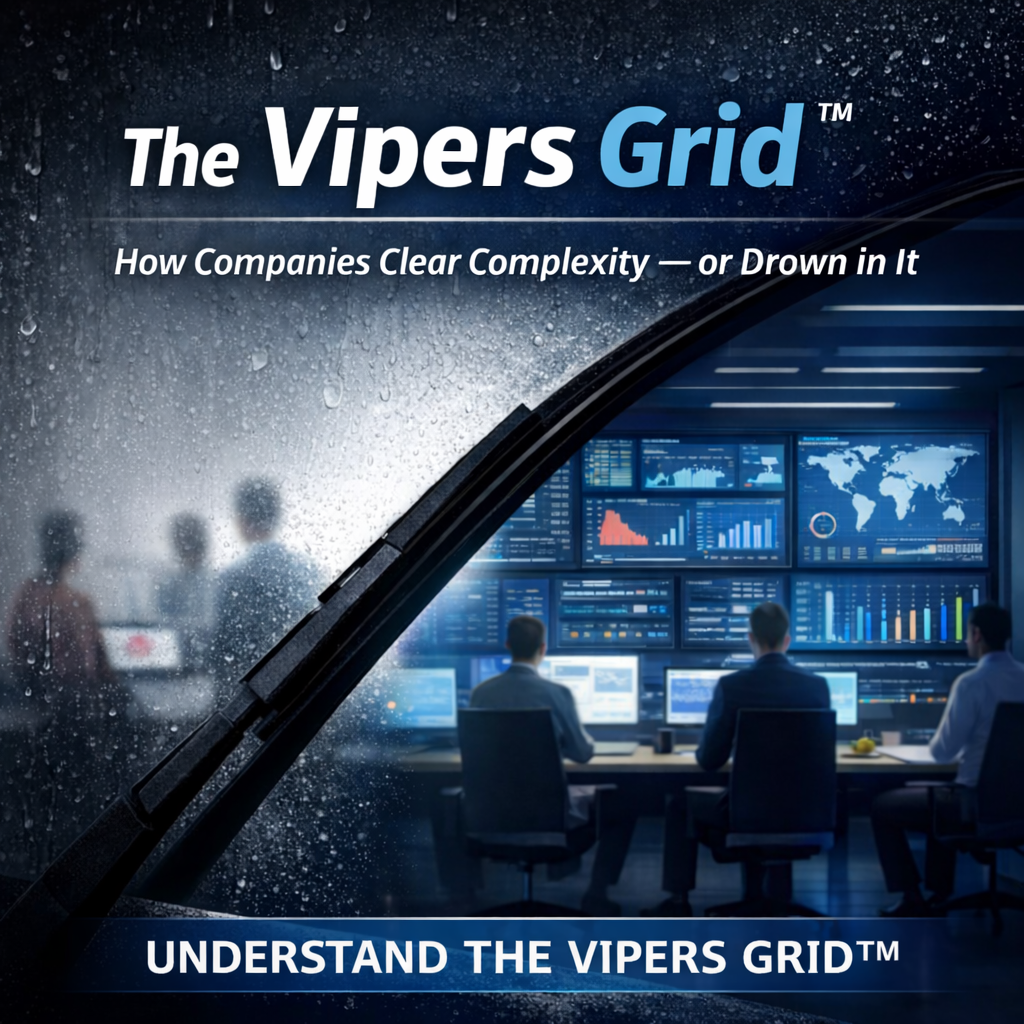
How Companies Clear Complexity — or Drown in It
A Quantdig Original Framework
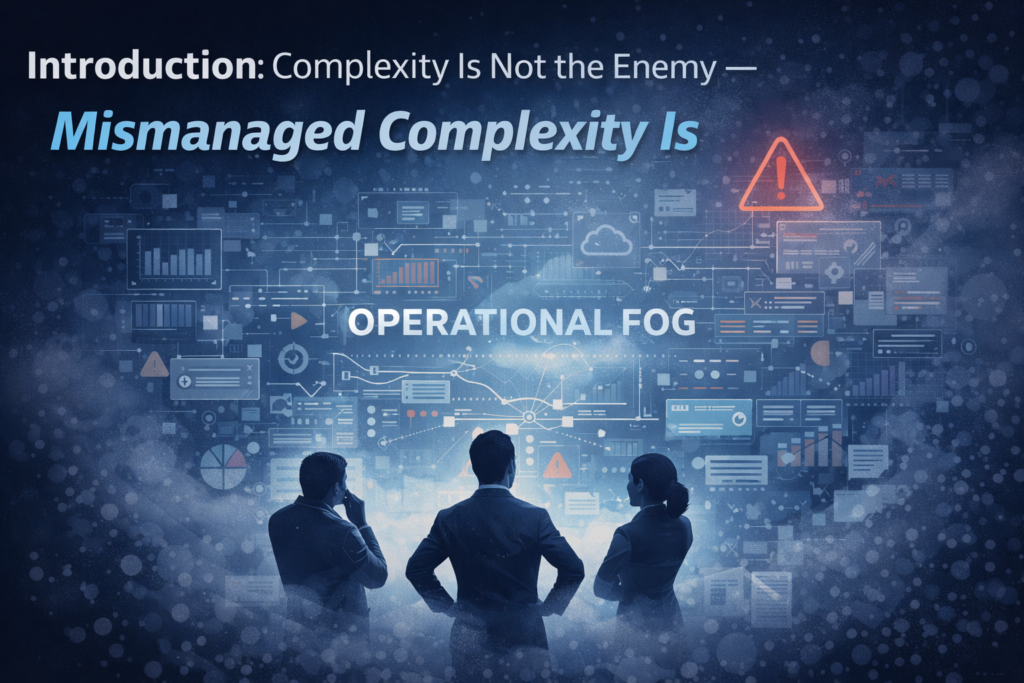
Introduction: Complexity Is Not the Enemy — Mismanaged Complexity Is
Modern companies don’t fail because markets are small or ideas are weak.
They fail because complexity grows faster than clarity.
More products.
More integrations.
More teams.
More tools.
More meetings.
And suddenly — no one knows what matters anymore.
At Quantdig, we call this invisible force Operational Fog.
To measure how companies deal with it, we built a framework:
The Vipers Grid™
1️⃣ The Windshield Problem


Imagine driving in heavy rain.
If your windshield wipers work well, you see clearly.
If they fail, you panic — even if the road hasn’t changed.
Businesses operate the same way.
- Market noise increases
- Customer demands evolve
- Technical debt accumulates
- Teams scale
The road (market opportunity) may still be clear.
But leadership can’t see it.
The question isn’t:
“Is the market complex?”
The question is:
“How strong are your wipers?”
2️⃣ The Two Axes of the Wipers Grid™
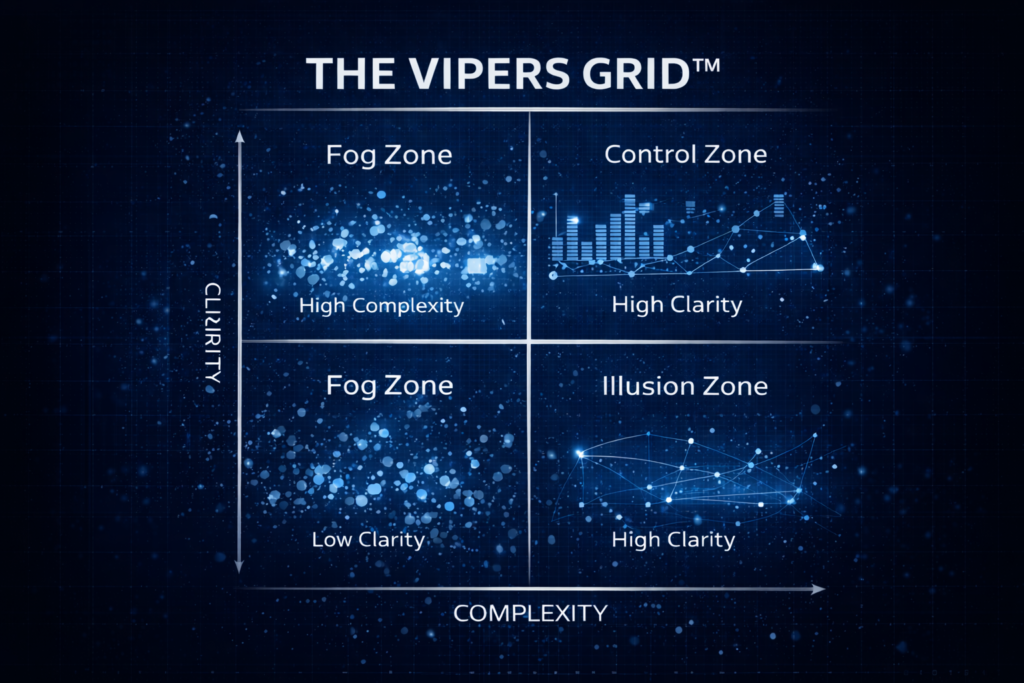
The Wipers Grid evaluates companies on two dimensions:
X-Axis: Complexity Load
- Product lines
- Technical architecture
- Organizational layers
- Regulatory exposure
- Market variability
Y-Axis: Clarity Systems
- Decision frameworks
- KPI alignment
- Architecture standards
- Incident response maturity
- Ownership accountability
When plotted, companies fall into one of four quadrants.
The Four Quadrants of the Vipers Grid™
🔴 1. The Fog Zone
High Complexity + Low Clarity

This is where most scaling startups land.
Symptoms:
- Endless meetings
- Roadmap confusion
- Constant firefighting
- Frequent production incidents
- Blame cycles
They are not incompetent.
They are overloaded without systems.
Growth becomes noise.
🟡 2. The Illusion Zone
Low Complexity + Low Clarity


This zone feels comfortable.
Why? Because complexity is still low.
The company believes:
- “We’re agile.”
- “We move fast.”
- “We don’t need process.”
But as soon as scale begins, cracks appear.
This is where overconfidence is born.
🔵 3. The Control Zone
Low Complexity + High Clarity

Disciplined small teams operate here.
They:
- Document decisions
- Track KPIs properly
- Maintain clean architecture
- Define ownership clearly
They may not be huge.
But they are ready to scale.
🟢 4. The High-Performance Zone
High Complexity + High Clarity

This is where elite companies operate.
They handle:
- Massive scale
- Multiple products
- Global users
- Heavy compliance
Yet they remain calm.
Why?
Because clarity systems evolve with complexity.
Examples of this zone often include firms like
Amazon,
Stripe,
and Microsoft.
Not because they are big —
but because they built wipers before the storm.
Why Most Companies Slip


Most organizations invest in:
- Marketing
- Hiring
- Product expansion
But they underinvest in:
- Decision architecture
- Incident learning systems
- Observability
- Process clarity
- Accountability mapping
So complexity rises — but clarity stays flat.
That’s when delivery confidence collapses.
How to Strengthen Your Wipers
If you’re in the Fog Zone, focus on:
- Decision Documentation
- Clear Ownership Maps
- Architecture Governance
- Incident Retrospective Discipline
- KPI Simplification

Clarity doesn’t reduce complexity.
It makes complexity survivable.
Final Thought: Rain Is Guaranteed
Markets will evolve.
Tech stacks will grow.
Teams will scale.
Rain is guaranteed.
The only real strategic question is:
Are you building a bigger car — or better wipers?
About This Framework
The Vipers Grid™ is part of the
Quantdig Originals — Framework-Based IP Series,
designed to evaluate execution maturity beyond buzzwords.