The Companies Winning Quietly in the AI Race

The AI race has become incredibly loud.
Every week, a new company claims it has built the future. A new model dominates benchmarks. A new demo floods social media with excitement, fear, and predictions about the end of human work.
The spotlight is everywhere.
But history suggests something uncomfortable:

The companies receiving the most attention during a technological revolution are rarely the ones quietly accumulating the most power.
Because while the world watches the products, the real leverage is usually being built underneath them.
In every gold rush, attention follows the miners.
Wealth follows the infrastructure.
The internet created flashy websites, but cloud providers built empires. Mobile apps exploded globally, but platform owners controlled the ecosystems underneath them. Social media created influencers, but the platforms captured the leverage.

AI is beginning to repeat the same pattern.
Only this time, the infrastructure layer is becoming even more powerful.
Visual Inspiration

Most people assume the winners of AI will simply be the companies building the smartest models.
But intelligence itself is rapidly becoming commoditized.
Models improve weekly. Capabilities spread instantly. Open-source alternatives appear overnight. Features that once looked revolutionary become standard faster than anyone expected.
Infrastructure behaves differently.
Infrastructure compounds.
Once a company becomes deeply embedded inside workflows, cloud systems, APIs, enterprise operations, or developer ecosystems, replacing it becomes painfully expensive.
That is where invisible leverage begins.
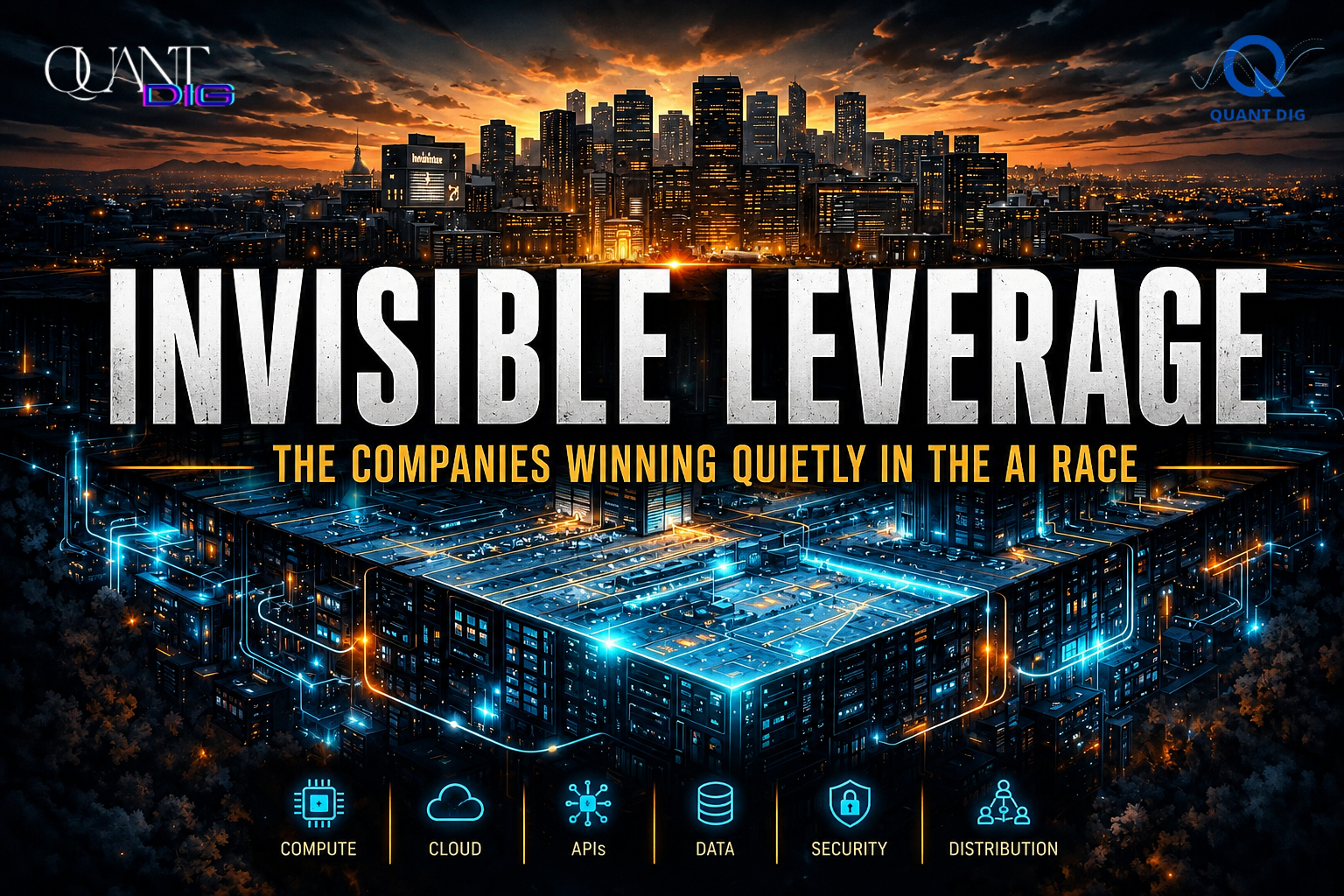
The modern AI stack is quietly creating a new hierarchy of power.
At the surface are the visible companies everyone talks about:
chatbots, assistants, AI agents, image generators, viral productivity tools.

But underneath sits another layer most people barely notice.
GPU providers.
Cloud platforms.
Inference engines.
Data pipelines.
Enterprise integrations.
Security systems.
Observability layers.
Developer ecosystems.
These companies may not dominate headlines.

But they are becoming dependencies.
And dependencies are where enduring power lives.
Visual Inspiration

The most dangerous form of power is the kind that becomes invisible.
Once workflows depend on your infrastructure, customers stop thinking about alternatives. Teams train around your systems. Developers build directly into your ecosystem. Operations harden around your architecture.

At that point, competitors are no longer fighting a product.
They are fighting gravity itself.
That is why the strongest technology companies often appear boring before they appear unstoppable.

The companies speaking the loudest about AI today may not necessarily dominate tomorrow.
Because attention creates momentum.
But infrastructure creates permanence.
And permanence compounds quietly while everyone else is distracted by the noise.
Closing Visual


“The loudest revolutions often hide where power is actually accumulating.”